CMP 50 Mixed Production (Block and Car)
CMP 50 Mixed Production (Block and Car)
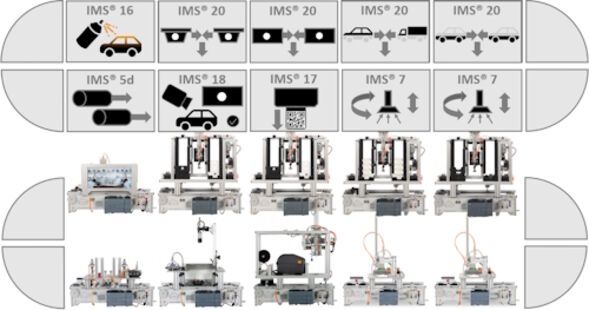
This system is used to train all of the required working steps. Starting from the conception, through the mechanical assembly of the facility all the way to the programming of a fully automated production line. The journey goes from the basic principles of individual subsystems all the way to the advanced programming and networking of entire production systems. With this system not only three-part blocks but cars can be produced. A multi-part car with integrated operational pcbs, chassis and different car bodies is completely assembled and “painted” on a fully automated production line. Subsequently a quality control phase takes place including individual labelling. Using an imprinted QR code the production sides of the products can be called up via mobile end devices. A detailed overview of all production data can be monitored. Using a QR code and AR-capable end devices it is possible to project and observe a 3D model of the ordered product on the table.
Training content:
- Create TIA-Portal projects
- Become familiar with mechatronic systems
- Convert mechanical operations into programmable sequential operations
- PLC programming of sequential control systems
- Integration, i.e. Networking of individual systems into production lines
- Implementation of full-automated production lines
- Networking of an ERP system with the production line
Your benefits:
- Modularity of the systems
- Usage of genuine industrial components
- Self-study courses to explore and work through requirements
- Flexible project situations
- Multiple extension options Including:
- Augmented Reality
- Robotics
Equipment set comprising the following:
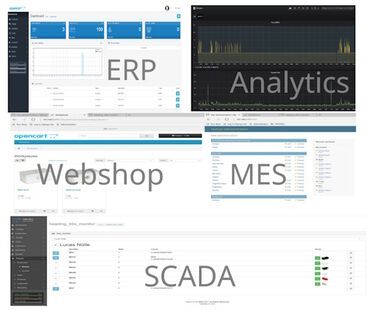
Learning Content:
Fundamentals of Industry 4.0 and ERP Systems
- Introduction to ERP: Basic understanding ("What is an ERP system?" and "How does it work?"), taught through the Interactive Lab Assistant course.
- The ERP Lab: Getting to know a didactically prepared ERP and MES system without a long training period.
- IoT and Edge Cloud: How communication works between cloud services, servers, and IoT devices within the production environment.
Configuration and Project Engineering
- System Setup: Step-by-step connection and basic configuration of the ERP Lab.
- Hardware Adaptation: Flexible adaptation of the ERP system to physical hardware changes in the plant.
- Project Work: Practical implementation of specific projects, such as connecting transport systems to the ERP Lab and configuring complete production lines.
- PLC Programming: Programming the integrated programmable logic controllers for a smooth production process.
Production Control and MES Functions
- Production Planning: Intelligent, near-real-time control of production (e.g., batch production with 12 variants or car production with over 50,000 variants).
- Parallel Plant Control: Simultaneous management and control of multiple production lines.
- SCADA and Plant Monitoring: Real-time monitoring of the plant as well as production data acquisition (PDA) and machine data acquisition (MDA).
- Warehouse Management: Manual and fully automated monitoring of magazine fill levels (via IO-Link sensors).
Interfaces and Network Communication
- Industrial Protocols: Practical application of communication standards OPC UA (controller to ERP), MQTT (real-time user interface updates), and REST (machine-readable data).
- Database Management: Access, management, and export of production data from an integrated MySQL database.
Enterprise Resource Planning and E-Commerce
- Webshop Integration: Configuration of an online shop for personalized ordering via browser, including dynamic pricing for different product variants.
- Commercial Processes: Calculation of production and material costs, creation of sales orders, as well as printing of delivery notes and invoices.
- Live Tracking: Real-time view of the production process, delivery times, and order lists for the customer.
Statistics and Energy Balancing
- Data Analysis: Evaluation of extensive statistics (e.g., number of workpieces used, quantities produced, regional delivery overviews).
- Energy Efficiency: Measurement of current and voltage on the transport systems to create detailed energy balances for individual orders.
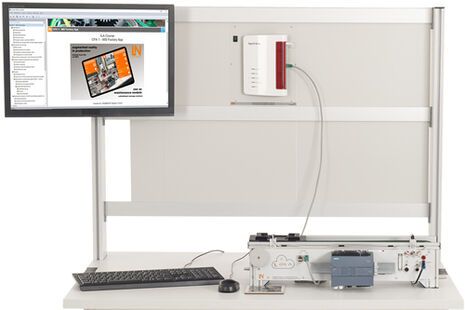
IMS Factory App:
In the age of the smart factory (Industry 4.0), when technology is progressing in leaps and bounds, it is also necessary to modernise the area of service and maintenance. Not only the monitoring of manufacturing operations and production lines but also manual intervention and process control must also give way to possibilities provided by new technologies. Maintenance modules which had to be connected via cable or which only provided instructions via PDF files on the screen used to be state-of-the-art technology in the run up to the smart factory (Industry 3.0).
Operation and monitoring using lists can quickly get confusing in a process with many different signals. Assigning signals to sensors located in the machine locally can take a lot of time. This makes it all the more beneficial to have a wireless connection of the maintenance module to the machine and a depiction of the signals in an AR (augmented reality) environment. In augmented reality, the image shown on the screen via the camera depicts the control signals at the actual location where they are also located in the machine. This way, the signal states or error messages can be rapidly located, identified and prioritized. This makes it possible to achieve shorter downtimes.
The definition and positioning of the signals is customised and can be defined at the operator's discretion. Also the configuration of the machinery in the production line can be determined at will. The Augmented Reality App establishes the WiFi connection to the machine. Communication is carried out via the defined IP addresses.
Course content:
- Fundamentals of augmented reality (AR)
- Communication between PLC and app
- Configuration of the app
- Definition of the segments
- Definition of routes
- Configuration of the signals
- Free positioning of the signals in AR
- Configuration of error messages
- Signal types and control types
- Maintenance
- Choice of routes
- Test the signals in the list view
- Test the error messages in the list view
- Testing the signals in AR
- Carrying out maintenance in AR
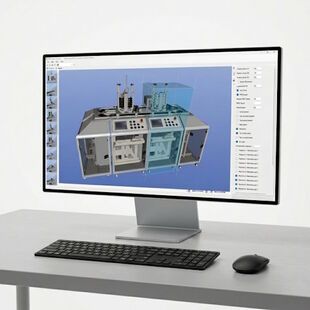
IMS Virtual:
System Understanding and Plant Structure
- Analysis of production processes: Getting to know the functionality and system structure of complex production plants.
- Plant operation: Centralized operation and monitoring of plants and processes in a safe, virtual environment.
- Working with plant libraries: Utilizing a comprehensive library of fully functional mechatronic stations and complete plants.
Programming, Parameterization, and Commissioning
- Practical commissioning: Parameterization, programming, and step-by-step commissioning of technologically diverse plants.
- Control technology: Setup and programming of the control system for virtual 3D models – optionally via PLCSIM or a connected real hardware PLC.
- Real-time validation: Verification of the programmed behavior through highly detailed and visually descriptive 3D real-time simulations, including collision detection.
Applied Technologies and Sensor Systems
- Drive and measurement technology: Implementation of speed control via pulse-width modulation (PWM) and exact positioning using incremental encoders.
- Object detection: Level measurement in magazines using ultrasonic sensors.
- Identification systems: Data transfer and object identification via RFID read/write heads.
- Signaling: Visual status display via integrated LED strips.
Systematic Diagnostics and Fault Simulation
- Incident management: Recognizing and responding to practically simulated faults within the process simulation.
- Targeted troubleshooting: Conducting systematic troubleshooting on production plants under realistic conditions.
- Fault configuration: Analysis of deliberately induced faults, such as the misalignment of sensors or manipulated electrical and physical properties of components.

Media:
Accessories:
Variant also available: (anthracite/oak) via item no. ST7200-7A_SE