Learning Content:Fundamentals of Industry 4.0 and ERP Systems
Learning Content:
Fundamentals of Industry 4.0 and ERP Systems
- Introduction to ERP: Basic understanding ("What is an ERP system?" and "How does it work?"), taught through the Interactive Lab Assistant course.
- The ERP Lab: Getting to know a didactically prepared ERP and MES system without a long training period.
- IoT and Edge Cloud: How communication works between cloud services, servers, and IoT devices within the production environment.
Configuration and Project Engineering
- System Setup: Step-by-step connection and basic configuration of the ERP Lab.
- Hardware Adaptation: Flexible adaptation of the ERP system to physical hardware changes in the plant.
- Project Work: Practical implementation of specific projects, such as connecting transport systems to the ERP Lab and configuring complete production lines.
- PLC Programming: Programming the integrated programmable logic controllers for a smooth production process.
Production Control and MES Functions
- Production Planning: Intelligent, near-real-time control of production (e.g., batch production with 12 variants or car production with over 50,000 variants).
- Parallel Plant Control: Simultaneous management and control of multiple production lines.
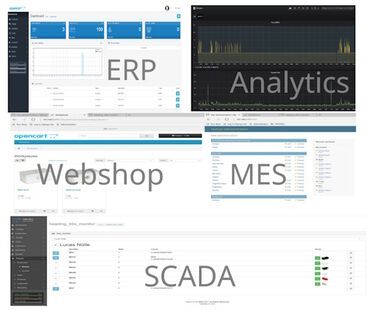
- SCADA and Plant Monitoring: Real-time monitoring of the plant as well as production data acquisition (PDA) and machine data acquisition (MDA).
- Warehouse Management: Manual and fully automated monitoring of magazine fill levels (via IO-Link sensors).
Interfaces and Network Communication
- Industrial Protocols: Practical application of communication standards OPC UA (controller to ERP), MQTT (real-time user interface updates), and REST (machine-readable data).
- Database Management: Access, management, and export of production data from an integrated MySQL database.
Enterprise Resource Planning and E-Commerce
- Webshop Integration: Configuration of an online shop for personalized ordering via browser, including dynamic pricing for different product variants.
- Commercial Processes: Calculation of production and material costs, creation of sales orders, as well as printing of delivery notes and invoices.
- Live Tracking: Real-time view of the production process, delivery times, and order lists for the customer.
Statistics and Energy Balancing
- Data Analysis: Evaluation of extensive statistics (e.g., number of workpieces used, quantities produced, regional delivery overviews).
- Energy Efficiency: Measurement of current and voltage on the transport systems to create detailed energy balances for individual orders.